Pedestrian Accidents at Night: How Visibility Affects Liability in California
By Andy Van Le
Quick Answer
When a pedestrian is hit by a vehicle at night in California, poor visibility does not automatically determine who is at fault.
Drivers have a duty to exercise due care for pedestrians, and California law requires drivers to yield to pedestrians crossing within marked or unmarked crosswalks at intersections. Pedestrians also have responsibilities for their own safety. When crossing outside a marked or unmarked crosswalk, for example, a pedestrian must yield to vehicles close enough to constitute an immediate hazard.
In a nighttime pedestrian accident, the investigation may consider street lighting, headlights, vehicle speed, the location of the pedestrian, traffic signals, crosswalks, clothing visibility, driver attention, sight distance, and whether either party had a reasonable opportunity to avoid the collision.
If you've been injured while walking, learn more about your legal rights after a pedestrian accident.
Why Nighttime Pedestrian Accidents Can Be So Complicated
Pedestrian accidents can happen in seconds.
At night, determining exactly what happened may become even more complicated.
A driver might say:
“I couldn't see the pedestrian until it was too late.”
The pedestrian might say:
“I was already crossing the street when the car hit me.”
Those statements raise several questions.
Where was the pedestrian?
Was there a crosswalk?
How well was the street illuminated?
How fast was the vehicle traveling?
Were its headlights functioning?
Was the driver distracted?
How far away should the driver have been able to see the pedestrian?
Did either person have enough time to react?
These cases shouldn't be decided solely by someone's statement that the pedestrian was “hard to see.”
The surrounding evidence matters.
California Drivers Have a Duty Toward Pedestrians
California Vehicle Code §21950 requires a driver to yield the right-of-way to a pedestrian crossing within a marked crosswalk or an unmarked crosswalk at an intersection.
The statute also requires an approaching driver to exercise due care and reduce speed or take other necessary action to safeguard a pedestrian.
At the same time, pedestrians have responsibilities.
A pedestrian cannot suddenly leave a curb or other place of safety and move into the path of a vehicle that is so close as to constitute an immediate hazard.
That means pedestrian accident liability is highly dependent on the facts.
What About Pedestrians Crossing Outside a Crosswalk?
California law also addresses pedestrians crossing somewhere other than a marked crosswalk or an unmarked crosswalk at an intersection.
Vehicle Code §21954 generally requires a pedestrian crossing at such a location to yield to vehicles close enough to constitute an immediate hazard.
However—and this is important—the same statute expressly states that this does not relieve the driver of the duty to exercise due care for pedestrian safety.
So a pedestrian being outside a crosswalk does not automatically answer the liability question.
The circumstances still need to be investigated.
How Does Darkness Affect a Pedestrian Accident Case?
Darkness can affect several parts of the liability analysis.
The issue isn't simply:
Was it dark?
Instead, I would want to know:
- What could the driver reasonably see?
- How far ahead was the roadway visible?
- Was the area illuminated?
- Were the vehicle's headlights working?
- How fast was the vehicle moving?
- Where did the pedestrian enter the roadway?
- How long was the pedestrian visible?
- Was the driver paying attention?
- Could the driver reasonably have slowed or stopped?
Those details can help determine whether poor visibility truly made the collision unavoidable or whether the driver failed to respond appropriately to the conditions.
Street Lighting Can Be Important Evidence
Not every nighttime roadway has the same visibility.
One accident might occur at a brightly illuminated downtown intersection.
Another might happen on a poorly lit residential street.
Another could happen on a dark stretch of roadway with few streetlights.
Photographs taken during daylight don't necessarily show what a driver could see at the time of a nighttime accident.
In some cases, it can be helpful to document the scene under lighting conditions similar to those present when the collision occurred.
Investigators may consider:
- Streetlight locations
- Whether lights were functioning
- Nearby businesses
- Illuminated signs
- Shadows
- Trees or landscaping
- Parked vehicles
- Buildings or other visual obstructions
All of these may affect visibility.
Headlights May Matter
Vehicle headlights are obviously important at night.
An investigation may consider whether:
- Both headlights were functioning
- The headlights were properly aimed
- High or low beams were being used appropriately
- The lenses were damaged or obstructed
- The vehicle's lighting system had a problem
Headlights don't necessarily eliminate every visibility problem.
But their condition can become relevant when a driver claims a pedestrian could not be seen.
Speed Can Change Everything at Night
Speed affects both how much time a driver has to recognize a pedestrian and how much distance is available to stop.
Even when a driver is traveling below the posted speed limit, the circumstances may still matter.
Nighttime visibility, traffic, weather, roadway design, and pedestrian activity can all affect what constitutes safe driving under the circumstances.
A driver traveling too quickly for what they can actually see ahead may have less opportunity to react when a pedestrian becomes visible.
This is why investigators shouldn't look only at the posted speed limit.
The driver's actual speed and the surrounding conditions both matter.
What If the Pedestrian Was Wearing Dark Clothing?
This is a common issue in nighttime pedestrian cases.
An insurance company may argue that the pedestrian was wearing black or dark-colored clothing and was therefore difficult to see.
Clothing may be relevant to the visibility analysis.
But it doesn't automatically establish fault.
I would want to know much more:
- Was the pedestrian in a crosswalk?
- How long had the pedestrian been in the roadway?
- Was the intersection illuminated?
- Were headlights functioning?
- How fast was the driver traveling?
- Was the driver distracted?
- Were other pedestrians visible?
- Did witnesses see the pedestrian?
- Was there video of the accident?
The clothing is one fact among many.
What If the Driver Says, “They Came Out of Nowhere”?
I've heard versions of this statement in accident cases many times.
But people don't literally appear out of nowhere.
The question is when the pedestrian became visible or reasonably should have become visible to an attentive driver.
That can sometimes be investigated using physical evidence.
For example, surveillance video may show that a pedestrian had already been walking across several lanes before impact.
Or evidence may show that a pedestrian suddenly entered the roadway immediately in front of the vehicle.
Those are very different scenarios.
Crosswalk Location Can Be Critical
Whether the pedestrian was in a marked or unmarked crosswalk can significantly affect the analysis.
California Vehicle Code §21950 expressly addresses pedestrians crossing within marked crosswalks and unmarked crosswalks at intersections.
Many people don't realize that a crosswalk does not necessarily need painted lines to exist at an intersection.
That's why simply saying “there wasn't a painted crosswalk” may not resolve the issue.
The actual roadway and intersection configuration need to be examined.
Traffic Signals and Pedestrian Signals
At signal-controlled intersections, the traffic lights and pedestrian signals can become critical evidence.
Investigators may need to determine:
- What signal the driver had
- What signal the pedestrian had
- When each signal changed
- When the pedestrian entered the roadway
- Where the vehicle was when the pedestrian began crossing
Video can be especially useful when the parties disagree about which signal was displayed.
Distracted Driving at Night
Visibility isn't always the real problem.
Sometimes the driver simply wasn't looking.
Potential distractions may include:
- Cell phones
- Navigation systems
- Text messages
- Passengers
- Food or drinks
- Adjusting vehicle controls
- Looking away from the roadway
A driver who claims “I never saw the pedestrian” may raise the question of why.
Was the pedestrian genuinely impossible to see?
Or was the driver not paying sufficient attention?
That distinction can be extremely important.
Impaired Driving Can Affect Nighttime Pedestrian Accidents
Alcohol and drugs can affect reaction time, judgment, attention, and perception.
If impairment is suspected, police records and other evidence may become important.
A nighttime collision near restaurants, bars, entertainment districts, or similar areas may require careful investigation of the driver's actions before the accident.
The presence of impairment is a factual question that needs evidence.
Can a Pedestrian Be Partially Responsible?
Potentially, yes.
California law imposes responsibilities on pedestrians as well as drivers.
For example, Vehicle Code §21950 states that pedestrians must use due care and may not suddenly enter the path of a vehicle that is so close as to create an immediate hazard. Section 21954 also addresses pedestrians crossing outside marked or unmarked intersection crosswalks.
California's comparative-fault principles can potentially divide responsibility when more than one person's conduct contributed to an accident.
That means a pedestrian being partially responsible does not necessarily mean the pedestrian has no claim.
The specific percentages of responsibility can affect the recovery.
Surveillance Video Can Be Extremely Valuable
Nighttime pedestrian accidents often occur near:
- Restaurants
- Gas stations
- Convenience stores
- Apartment buildings
- Hotels
- Parking garages
- Shopping centers
- Office buildings
- Homes with security cameras
Those locations may have cameras.
Video might show:
- When the pedestrian entered the roadway
- The pedestrian's location
- Vehicle speed or movement
- Traffic signals
- Other vehicles
- Lighting conditions
- Whether the driver braked
- The point of impact
Because surveillance recordings may be overwritten, identifying cameras quickly can be important.
Dash-Camera Footage
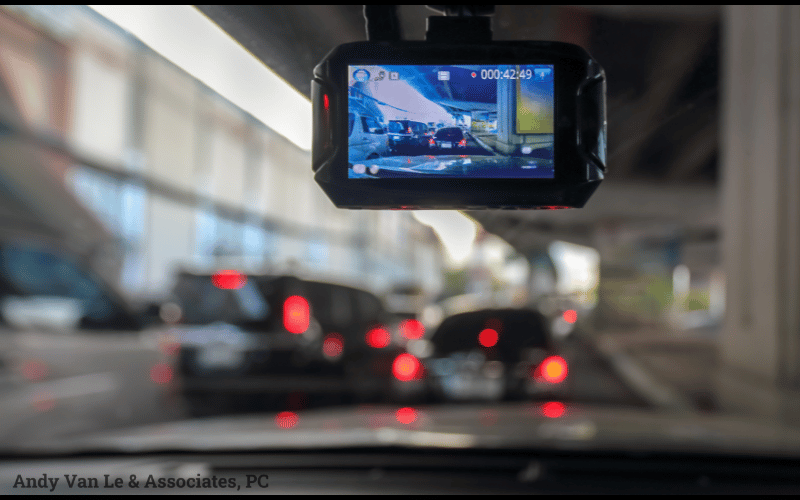
Dash cameras can provide another valuable source of evidence.
A recording may show the accident itself or the moments immediately before it.
Even a dash camera from an uninvolved vehicle may help establish:
- Lighting
- Traffic conditions
- Signal timing
- Vehicle movements
- Pedestrian location
If witnesses mention having dash-camera footage, that evidence should be preserved.
Vehicle Damage Can Help Reconstruct the Collision
The location of damage on the vehicle may also provide information.
Investigators may look at:
- Windshield damage
- Hood damage
- Bumper damage
- Side-mirror damage
- Other impact points
This information may help establish the collision dynamics when considered with photographs, video, roadway evidence, and witness statements.
Accident Reconstruction May Be Necessary
In serious pedestrian cases, an accident reconstruction professional may sometimes evaluate the available evidence.
The analysis could include:
- Vehicle speed
- Stopping distance
- Reaction time
- Sight distance
- Point of impact
- Roadway design
- Lighting
- Physical evidence
- Video
- Vehicle damage
The goal is to determine what the available evidence can tell us about the seconds leading up to the collision.
What If the Pedestrian Wasn't in a Crosswalk?
Don't automatically assume there is no case.
As noted above, California Vehicle Code §21954 requires pedestrians crossing outside a marked or unmarked intersection crosswalk to yield to vehicles that are close enough to constitute an immediate hazard.
But the law also specifically preserves the driver's duty to exercise due care for pedestrian safety.
For example, imagine a pedestrian is already well into the roadway and visible for an extended period before being struck by a distracted driver.
That presents a very different factual situation from a pedestrian suddenly stepping directly in front of an approaching vehicle.
This is why the evidence matters.
What Injuries Can Result From a Pedestrian Accident?
Pedestrians have virtually no physical protection when struck by a vehicle.
Serious injuries may include:
- Traumatic brain injuries
- Skull fractures
- Spinal injuries
- Broken bones
- Pelvic injuries
- Leg and knee injuries
- Internal injuries
- Facial injuries
- Severe lacerations
- Permanent disability
Some pedestrian accidents are fatal.
Because the injuries can be so severe, future medical treatment, lost earning capacity, and long-term care may become important considerations.
What Should You Do After a Pedestrian Accident?
Medical care should come first.
If you're physically able, useful steps may also include:
- Calling law enforcement
- Identifying witnesses
- Photographing the scene
- Photographing your injuries
- Identifying nearby cameras
- Saving damaged clothing or personal items
- Keeping medical records
- Keeping insurance communications
- Avoiding unnecessary statements about fault
If the accident happened at night, documenting the location under similar nighttime conditions may also help preserve information about visibility.
Why These Cases Should Be Investigated, Not Assumed
When a pedestrian is struck at night, it's easy for someone to immediately say:
“The driver couldn't see them.”
Or:
“The pedestrian had the right-of-way, so the driver must be completely at fault.”
Neither assumption necessarily resolves the case.
The better questions are:
Where was everyone?
What did the law require?
What could each person reasonably see?
How much time did they have to react?
What does the independent evidence show?
That's how I believe a serious pedestrian accident should be evaluated.

Speak With a San Diego Pedestrian Accident Lawyer
If you or a family member has been struck by a vehicle while walking in San Diego, don't assume an insurance company's initial version of the accident is the final answer.
At Accident Law Center, I help injured pedestrians understand their rights and investigate the circumstances surrounding serious accidents.
Learn more about your legal rights after a pedestrian accident.
Call (619) 525-0001 or contact our office for a free consultation.
Legal Disclaimer
This article is for informational purposes only and does not constitute legal advice. Reading this article does not create an attorney-client relationship with Andy Van Le & Associates, PC. Pedestrian accident liability depends on the particular facts, evidence, and applicable law. Contact an attorney directly for advice regarding your specific circumstances.
Frequently Asked Questions
Who is at fault if a pedestrian is hit at night in California?
There is no automatic rule that determines fault simply because the accident happened at night. Liability may depend on where the pedestrian was crossing, right-of-way, lighting, vehicle speed, driver attention, visibility, traffic signals, and other evidence.
Do California drivers have to yield to pedestrians in crosswalks?
California Vehicle Code §21950 generally requires drivers to yield to pedestrians crossing within marked crosswalks or unmarked crosswalks at intersections. Drivers approaching pedestrians in those crosswalks must also exercise due care.
Is a pedestrian automatically at fault if they cross outside a crosswalk?
No. Vehicle Code §21954 generally requires a pedestrian crossing outside a marked or unmarked intersection crosswalk to yield to vehicles close enough to constitute an immediate hazard, but the statute also preserves the driver's duty to exercise due care for pedestrian safety.
Does wearing dark clothing make a pedestrian responsible for an accident?
Dark clothing may be relevant when evaluating nighttime visibility, but it does not by itself determine legal responsibility. The entire accident—including location, lighting, speed, right-of-way, driver attention, and other evidence—should be evaluated.
Can a pedestrian be partially at fault for an accident?
Yes. Depending on the facts, California comparative-fault principles may result in responsibility being divided when both the driver and pedestrian contributed to the accident.
What evidence can help prove a nighttime pedestrian accident?
Evidence may include surveillance video, dash-camera footage, photographs, witness statements, police records, traffic-signal information, vehicle damage, roadway evidence, lighting conditions, and accident reconstruction.
Can a pedestrian still have a claim if they weren't in a crosswalk?
Potentially. The location of the pedestrian is important, but California law still requires drivers to exercise due care for pedestrians in the roadway. The specific circumstances determine how responsibility should be evaluated.